
 ქართული
 Русский
What do 1550 and 1927 nm fractional lasers mean?

Sources reviewed: 25 October 2026.
Reading time: 2 min.
What do the two numbers tell us?
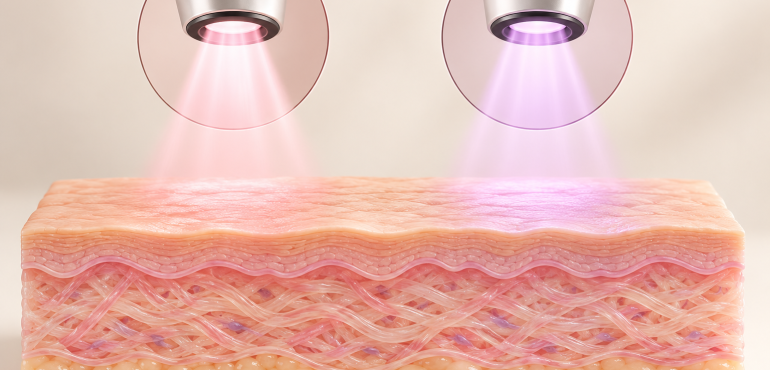
1550 and 1927 nm are wavelengths, not outcome ratings. A historical FDA document for Fraxel re:store Dual describes two laser sources and the distribution of thermal effects in tissue. Its specific indications do not automatically extend to another model or every current instruction for use.
Source: FDA K101490: Fraxel re:store Dual
What does fractional delivery mean?
The original fractional-photothermolysis study treated separated microscopic zones of skin. This distribution is an important principle. “Fractional” does not mean every laser produces the same effect; nonablative systems in this family should not be equated with CO₂ ablation channels.
Source: Fractional photothermolysis: original concept study
How broadly do study findings apply?
A study of 20 participants compared a 1927 nm fractional thulium approach with picosecond alexandrite for photopigmentation and signs of ageing. Both groups improved, with some assessments favouring the picosecond group. A small sample and differing treatment schedules cannot establish a universal ranking.
Source: 755nm picosecond versus 1927nm fractional thulium: randomized study
What matters for safety?
Skin-resurfacing procedures may cause infection, pigment changes or scarring. Discuss possible reactions and their management beforehand. “Nonablative” does not mean risk-free; the exact device and individual skin characteristics still matter.
Source: ASPS: Skin rejuvenation and resurfacing safety
What should we ask at consultation?
Ask which wavelength will be used and why. Two sources in a device do not automatically make both necessary. Relate questions to your main goal: what change is expected, how will it be measured and what alternatives exist? Offering another device under a familiar system’s name requires clarification of the actual model and documentation.