
 ქართული
 Русский
What is cryolipolysis, and why does the PAH risk matter?

Sources reviewed: 25 October 2026.
Reading time: 2 min.
Which important risk must not be overlooked?
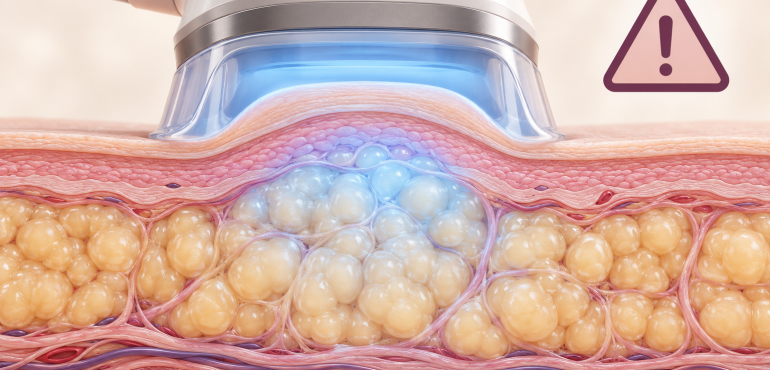
The FDA warns that treated fat sometimes enlarges after cryolipolysis instead of shrinking. Called PAH, this may require surgery.
Source: FDA: Non-invasive body contouring technologies
What does controlled cooling do?
Cryolipolysis uses cold to treat local fat deposits. The AAD discusses it among non-invasive fat-reduction options. Changing body contour and losing weight are different goals. Treating one area is not equivalent to a whole-body weight-management programme and cannot promise the same appearance for everyone.
Source: AAD: Non-invasive fat removal, what to expect
Do all studies show the same result?
A randomized trial of lower abdominal fat in women did not show the expected advantage from a single cryolipolysis session. This concerns a particular approach and group, not every application. Reading negative findings alongside positive advertising matters: the size and duration of change are not predetermined.
Source: Cryolipolysis for lower abdominal fat: randomized controlled trial
What can complication monitoring tell us?
A multicentre analysis of 2,114 patients described PAH cases and differences associated with device generation. These are retrospective data; a particular percentage should not be assigned to every model or person. Nonetheless, the complication is real and warrants advance discussion. A short-term photograph cannot provide a complete safety picture.
Source: Multicenter PAH evaluation: 8658 cycles in 2114 patients
What should we ask at consultation?
Request the exact device and applicator names. Ask what outcome is realistic and what happens if the change is unwanted. Understand the follow-up process and whom to contact for problems. Do not base your choice only on “without surgery”: discuss the goal, potential benefit and significance of possible complications together.
How should baseline and follow-up be compared?
Ask how differences in posture, lighting and camera angle will be controlled. Clarify when results will be assessed and how other changes will be considered. Satisfaction matters, but should not replace another measure. Different body goals should not disappear into a single word, “effect”; an agreed assessment makes the decision clearer.